
 By NewsRoom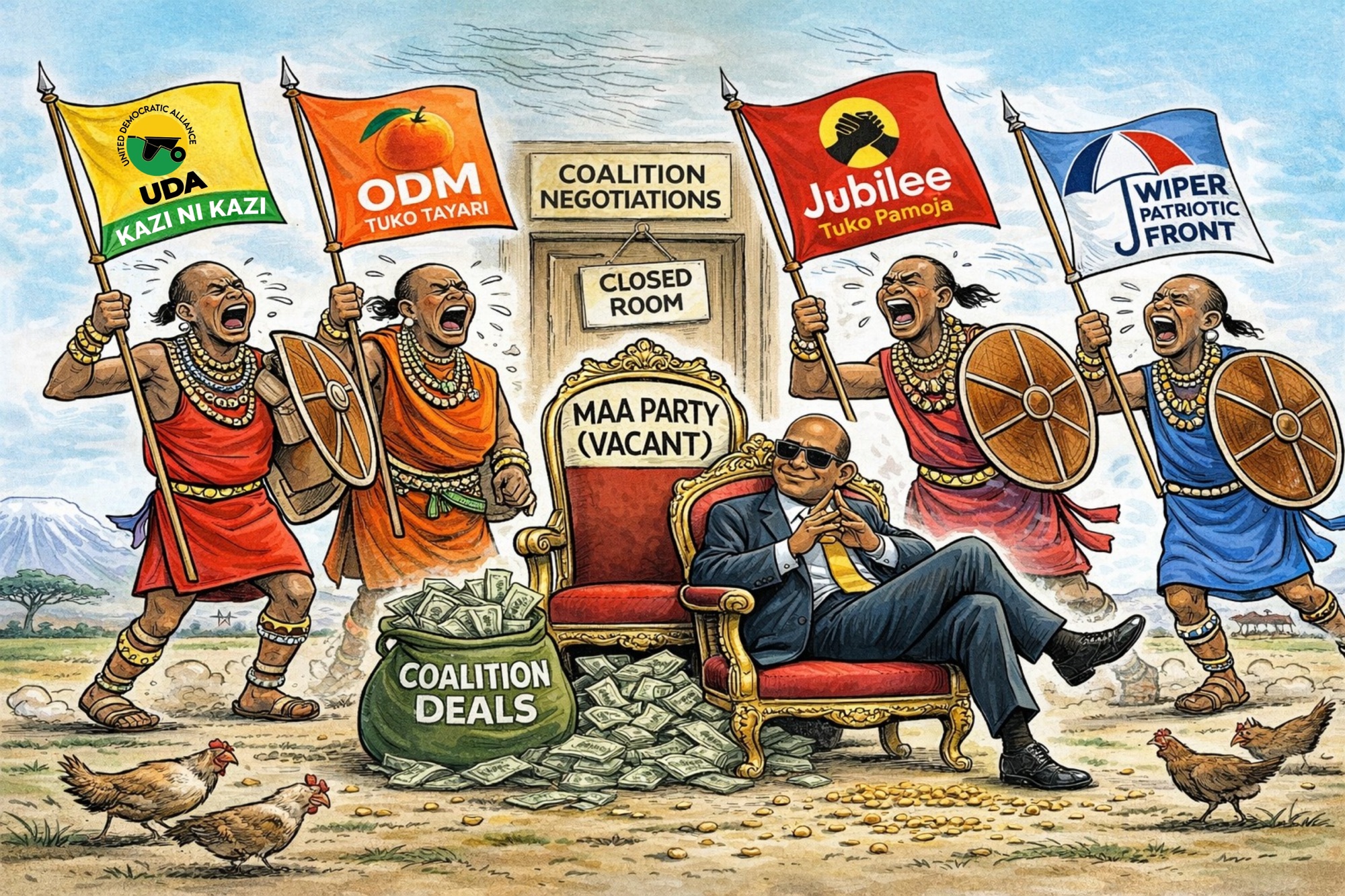
I remember one particular evening, the kind when the sun lingers, reluctant to leave the plains. We were seated in a loose circle near the oleng’oti, the smell of cattle and woodsmoke hanging quietly in the air. The kind of silence that does not ask questions, but somehow answers them. Ole Neboo, an elder of the Iseuri age set, sat slightly apart, his red shuka catching the last stubborn light. He was not a man who spoke often. And perhaps that is why, when he did, even the restless grew still. We were many.
But that evening, he spoke of one. A moran. He lost his entire herd. Not because he lacked courage. Not because he did not know how to fight. But because, when the raiders came…he stood alone.
Ole Neboo paused, pressed his stick into the dust, and said in a low, measured voice:
“Imeidim olenkaina nabo enking’arra — even an elephant, for all its strength, can be brought down by smaller forces when they unite.”
Some of us laughed lightly. But the plains do not lie. And time has a way of returning words to you when you are finally ready to understand them. I understand now. Politics, I have come to learn, obeys the same law. The Maa community’s central political problem is not that it has lacked brave men, eloquent leaders, wealthy patrons, or celebrated names. It is that it has lacked a durable political vehicle. That is the uncomfortable truth. We have mistaken men for institutions, noise for structure, and participation for power.
History offers a clue. Ole Tipis understood the grammar of power long before many of us learnt its alphabet. At Lancaster House, he is remembered for walking out when Maasai land rights were inadequately secured. He had insisted that land taken in the former White Highlands be addressed before independence could be sealed. It was the instinct of a man who knew that communities disappear politically long before they disappear physically. Land, for him, was not merely an economic asset. It was memory, leverage, continuity. His gesture contained a profound political philosophy: a people who do not secure their interests at the founding table spend generations negotiating from the margins. We celebrate Ole Tipis, and rightly so. But here lies the paradox. We inherited his grievance more faithfully than we inherited his institutional instinct.
The same pattern shadows the legacy of William ole Ntimama. In the 1990s, the legendary minister rose to immense power, defined by unflinching loyalty to KANU and a sharp, almost instinctive vigilance in defending Maa interests, especially on land. His rhetoric was as forceful as his politics. From the now-famous warnings of “lying down like envelopes” to his fierce posture during the Enosupukia clashes and the Mau chronicles, Ntimama spoke in a language that left no ambiguity about where he stood. He was not merely participating in power; he was shaping it.
At the height of his influence, he controlled the political rhythm of Narok with near-total authority. In one telling episode during a Narok South by-election, Tikoishi ole Nampaso; widely seen as the natural heir to his father’s political base, appeared poised for an easy victory. Yet, through the invisible hand of power, Ole Tuya, Ntimama’s preferred candidate, emerged as the winner. It was a moment that revealed not just influence, but hierarchy: Ntimama was not just in the system; he towered above it.
As a cabinet minister, his voice travelled far beyond Narok. He relentlessly pursued the restoration of Maasai lands alienated during the colonial era; stretching from Naivasha to Molo, Nakuru, Mau Narok, Kedong, Kitet, and Ndabibi. Many of those battles ended without resolution, but they cemented his reputation as a defender of historical justice. He died a celebrated hero, a man whose political shadow still lingers across Maa land.
But politics is often unkind to legacies that are not institutionalised. Today, his family; despite visible efforts, including those of Mama Lydia, struggles to command the same political gravity. That, perhaps, is the clearest lesson of all. The Maa did not lack a Ntimama. They lacked a vehicle that could outlive him.
Let us examine the political logic here. A community may produce charismatic leaders for a century and still remain structurally weak if those leaders operate within vehicles owned by others. That is where the Maa predicament lies. From Narok to Kajiado to Samburu, the Maasai have supplied votes to power without owning the machinery of power. They have campaigned energetically, negotiated loyalties, delivered numbers, sung at rallies, defended coalitions, and occupied public office. But in most cases they have done so through parties founded, branded, and psychologically anchored elsewhere. The result is that the Maa often appear in government, but rarely at the centre of agenda-setting. A community can be visible in government and still invisible in power. Power does not belong to those who appear. It belongs to those who organise.
This is why I have always found the frequent praise of the Maasai as “democratic” faintly amusing. In Kenya, a fragmented people are praised as democratic until election season ends and appointments begin. When Kalenjin voters consolidate, analysts call it discipline. When the Kikuyu vote cohesively, it is called strategic realism. When Luo voters rally behind one banner, it becomes a case study in loyalty. When Kamba voters stay within familiar formations, it is called consistency. But when the Maa distribute themselves across multiple parties, commentators suddenly discover the virtues of pluralism. One need not be cynical to detect the joke. The compliment is often an elegant insult. We are praised for the very fragmentation that weakens our bargaining power.
There is an old political allegory about a chicken being plucked slowly until it becomes too weak to resist. Then a few grains are tossed before it, and the same chicken follows the hand that wounded it. Cruel image, yes, but politics is not a children’s catechism. Communities that lack a durable vehicle are easy to pacify with symbolism and easy to mobilise with crumbs. A little patronage here, a token appointment there, a tender, a promise, a handshake, a roadside donation, a development launch, a flattering speech about culture, and the cycle resumes. It is easier to manage scattered people than to negotiate with an organised one. Power does not fear numbers. It fears structure.
The problem deepens because Kenyan politics, despite constitutional language about national character, still operates through regional cores wearing national suits. One need not be a tribalist to see this; one only needs eyesight. ODM’s emotional and organisational bedrock remains in Luo Nyanza. UDA’s centre of gravity has unmistakably been the Rift Valley. Wiper’s pulse beats strongest in Ukambani. Jubilee, in its heyday, spoke Mt Kenya with unusual fluency.
PAA is intelligible because the Coast chose to organise itself into a bargaining bloc. That organisation translated into real power; evident in Senator Amos Kingi’s rise to the position of Senate Speaker. Structure, once built, does not merely participate in power; it begins to shape it.
Even newer parties like the DCP, though draped in national rhetoric, often betray clear regional DNA. The pretence that Kenya has escaped regional political logic is comforting but false. We have not transcended that logic. We have merely become more sophisticated in disguising it.
Once that fact is accepted, the old objection to a Maa party begins to weaken. Some will say such a party would be tribal, narrow, or electorally weak. Fine. Let us entertain that objection seriously. It is true that a regional party can become parochial. It is true that Kenya needs national integration. It is true that no serious community should aspire to permanent isolation. But the objection fails for three reasons. First, almost every viable party in Kenya already has a regional soul even when it advertises a national face. Second, coalition politics rewards organised blocs, not scattered goodwill. Third, the purpose of a Maa party would not be to rule Kenya alone, but to ensure that the Maa negotiate Kenya from a position of coherence rather than dependency. A bargaining vehicle is not a secessionist flag. It is a seat at the table with one’s own cutlery. The objection, therefore, is not moral. It is selective.
A community that enters every coalition without its own vehicle eventually arrives nowhere. That sentence may sound severe, but history keeps confirming it. Junior partners without territorial clarity are eventually absorbed. Their leaders may be praised individually, accommodated briefly, or rewarded episodically, but the community itself remains structurally disposable. We are seeing such tensions even in the uneasy courtships of larger parties today. Without zoning, without spheres of influence, without defined political terrain, alliances become temporary transactions rather than durable compacts. Politics is arithmetic before it is emotion. A party gives a community arithmetic. Without it, one trades in sentiment and hopes for mercy.
Here lies the paradox. The Maasai are globally admired for identity, dress, cattle culture, resilience, beauty, and historical memory; yet in our own politics they are often told, subtly or openly, that they can only survive inside vehicles built by others. There was something revealing when Governor Ole Lenku floated the idea of a Maa political party and the response from Katoo ole Metito was not curiosity but dismissal. He reportedly reduced the concept to a “village party,” as though the globally revered Maa should accept permanent political tenancy as their natural station. That statement deserves to be preserved, if only because of what it inadvertently confessed. It suggested that the Maasai may dance at national feasts but should never own the music system. Did Lenku retreat under pressure? Did he choose caution over confrontation? The silence that followed has been loud. Time will tell. But silence, too, is political evidence.
History offers another clue. Maa politics has not been short of names. After Ole Tipis came the era shaped by powerful chiefs and later by Ntimama. Then devolution altered the map and multiplied the players. New constituencies emerged. New offices emerged. New families emerged. The puzzle became more intricate. In Narok, Tunai’s rise disrupted the long shadow of dominant sub-tribal arithmetic by giving smaller groups a taste of possibility. Patrick ole Ntutu then introduced his own logic of control and distribution, one that many read through the prism of clan balancing, patronage networks, and a different developmental style. In Kajiado, Lenku demonstrated political cunning many underestimated. In Samburu, other local equations prevailed. On paper, this looks like vitality. In practice, it often resembles multiplication without consolidation.
That is why the Maa political scene increasingly resembles a crossword puzzle in which every answer creates three new questions. Who is the future? Where is the future? When does the future begin? Will women find real room beyond ceremonial recognition? Will youth inherit a ladder or just an applause line? Every few years the phrase “future leaders” is repeated like a church chorus, yet the architecture that would reliably produce those leaders remains underbuilt. Without a common vehicle, young aspirants are left to seek adoption by clan patrons, wealthy families, external parties, or temporary factions. In the absence of structure, talent does not rise; it is selected. A serious party would not automatically solve the youth question, but it would create an arena within which leadership can be incubated, tested, and renewed.
Even scripture hints at this logic. The Israelites did not travel through history merely as scattered believers with good intentions. They moved as tribes, with structure, memory, hierarchy, and covenant. When that structure weakened, disorder followed. When it was restored, purpose returned. Even Christ, whose moral authority dwarfed earthly power, organised disciples instead of wandering alone as a solitary sage. Ideas survive through vessels. Faith itself recognises the need for form. It is therefore not enough for a community to have grievances, legends, and brilliant sons and daughters. It must have a container for continuity.
Niccolò Machiavelli, writing in a different register and a different moral universe, made a related point from the opposite direction. A people that wishes to remain merely good in a world of organised interest risks ruin. This is not a plea for cynicism. It is a plea for sobriety. One may attend church on Sunday and still acknowledge that politics has its own weather. In that weather, communities are not judged by how lyrical their speeches are, but by how coherent their leverage is. The Bible may teach blessed are the meek, but no serious reading of history suggests that the politically unstructured inherit much on earth.
Still, one must resist the temptation to romanticise a Maa party as a magic wand. A political vehicle can also become a briefcase, a family property, a patronage kiosk, or a bargaining chip for one man’s future. Kenya has more than enough parties that exist merely to auction loyalty at coalition season. The point, therefore, is not party registration for its own sake. The point is a durable vehicle rooted in philosophy, territorial seriousness, and community continuity. It must be broad enough to hold Narok, Kajiado, and Samburu in one strategic imagination without pretending they are identical terrains. It must create room for youth and women not as decorative appendages but as succession logic. It must treat land, education, pastoral economy, climate vulnerability, urban transition, and representation as core policy, not campaign ornament.
Any serious argument must pause to ask: is the ground ready? I think it is, though not automatically. Recent audits of representation have shown that many Kenyan communities remain marginal in upper tiers of public power while a few dominate state corporations and top appointments. One need not drown the reader in numbers to grasp the pattern. Representation in Kenya rarely obeys demographic innocence; it follows political organisation. That is why even relatively smaller but coherent blocs can punch above their weight. Structure magnifies voice. Fragmentation muffles it.
The real danger, however, is this: people can become so accustomed to surviving in borrowed houses that they start mocking the idea of building their own. Dependency then graduates from circumstance into philosophy. That may be the most destructive stage of all. Once a community internalises the belief that it cannot sustain a vehicle, it begins to celebrate adaptation as wisdom and misread subservience as pragmatism. It starts calling political tenancy realism. That is why dismissing a Maa party as a “village party” is not merely a tactical objection. It is an attempt, conscious or otherwise, to reduce political imagination.
And yet political imagination is precisely what history rewards. The Coast region read the signs early. They built PAA. They did not isolate themselves; they positioned themselves. They understood that in politics, if you do not carry your own spear, you will always fight in someone else’s war. There is a Maasai saying: a man who borrows a spear does not choose the battle. For too long, the Maasai have borrowed political spears.
Other regions have repeatedly rallied around vehicles whose value lies not in presidential inevitability but in negotiating power. A party does not need to conquer State House to matter. It needs to alter the terms on which its people enter coalition, policy, and appointments. It needs to ensure that when decisions are made about roads, land, schools, livestock markets, water, county boundaries, conservation, tourism revenues, and public jobs, the community is not represented by borrowed urgency.
This is why the central thesis must remain plain. The Maa community’s real political problem is not lack of leaders, but lack of a durable political vehicle. Everything else radiates from that. The complaints about fragmentation, the nostalgia for Ntimama, the anxiety over youth space, the irritation over tokenism, the suspicion of clanism, the recurring land question, the periodic excitement around one leader or another, even the bitterness at being called “democratic” for scattering votes: all these are symptoms of the same structural absence. We have had many horsemen. We have lacked a stable carriage.
If that thesis is correct, then the task ahead is not emotional but architectural. It is to think in terms of institution, not mood. To ask what kind of party can outlive one election cycle, one wealthy patron, one charismatic governor, one family feud, one coalition season. To ask how a Maa vehicle can be sufficiently local to command emotional legitimacy and sufficiently modern to survive constitutional scrutiny and national coalition politics. To ask not merely who leads it, but what habits, rules, and internal culture will prevent it from becoming another temporary shell. Serious political questions are often less romantic than they sound.
In the end, the matter may be put more simply. A people admired across the world for their dress, cattle, courage, memory, and unmistakable cultural confidence should not remain politically dressed in borrowed clothes. That is too soft a humiliation to provoke outrage and too persistent a condition to be called accidental. The Maasai do not need more praise for their democracy of dispersion. They need the discipline of organisation. Because in politics, as on the plains, a warrior may be brave, a spear may be sharp, and a herd may be beautiful. But without a kraal, night eventually tells its own story.
And history, as always, does not ask who was brave; it asks who was organised.
Author is a student of political systems and leadership, dissecting governance, history, and society with a voice that bridges local wisdom and global perspective.
For feedback, emails us at info@paran.co.ke
 paran
paran